
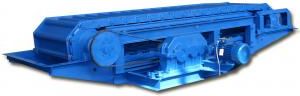
 Feeders are designed for transportation of bulk cargo on inclined or horizontal surface and are installed beneath raw materials bunker, herein performing not only transportation function but also dosing one.
Main branches of feeders application – metallurgical industry, mining industry, chemical production, coal industry. The difference of plate feeders is in the possibility to transfer raw materials under high (low) temperatures, herewith, it is possible to move oversized particles of material.
Productive capacity of plate feeders is on the average 400-600 t/h with pour density of transported material up to 4,0 t/m3.
Plate feeders are supplied in two versions:
- Heavy (for transportation of cargo with pour density from 3 to 4 t/m3 and thickness of particles not more than 0,6 of width of operating device). Feeders operating element of heavy type is equipped with moulded plates onto tractor type crawler drive.
- Light (for transportation of cargo with pour density from 1,0 to 3 t/m3 and thickness of particles not more than 0,3 of width of operating device). Feeders conveyer belt is pressed (curved) plates onto plate chains of calculated breaking strength.
Technical characteristics:
| Belt width, mm | 500 | 650 | 800 | 1000 | 1200 | 1600 | 2000 |
| Productive capacity, t/h | from 30 to 1000 | ||||||
| Belt speed, m/sec | from 0,2 to 0,7 | ||||||
| Feeder’s length, m | from 1 to 18 | ||||||
| Tightening device/Take-up | Screw take-up | ||||||
| Operating branch cross-section profile | flat with sideboards | ||||||
| Inclination of feeder at route, degrees | up to 8 | ||||||
| Carrying rollers diameter, mm | from 102 to 159 | ||||||
| Drive drum diameter, mm | 500…1000 | ||||||
| Tightening drum diameter, mm | 500…800 | ||||||